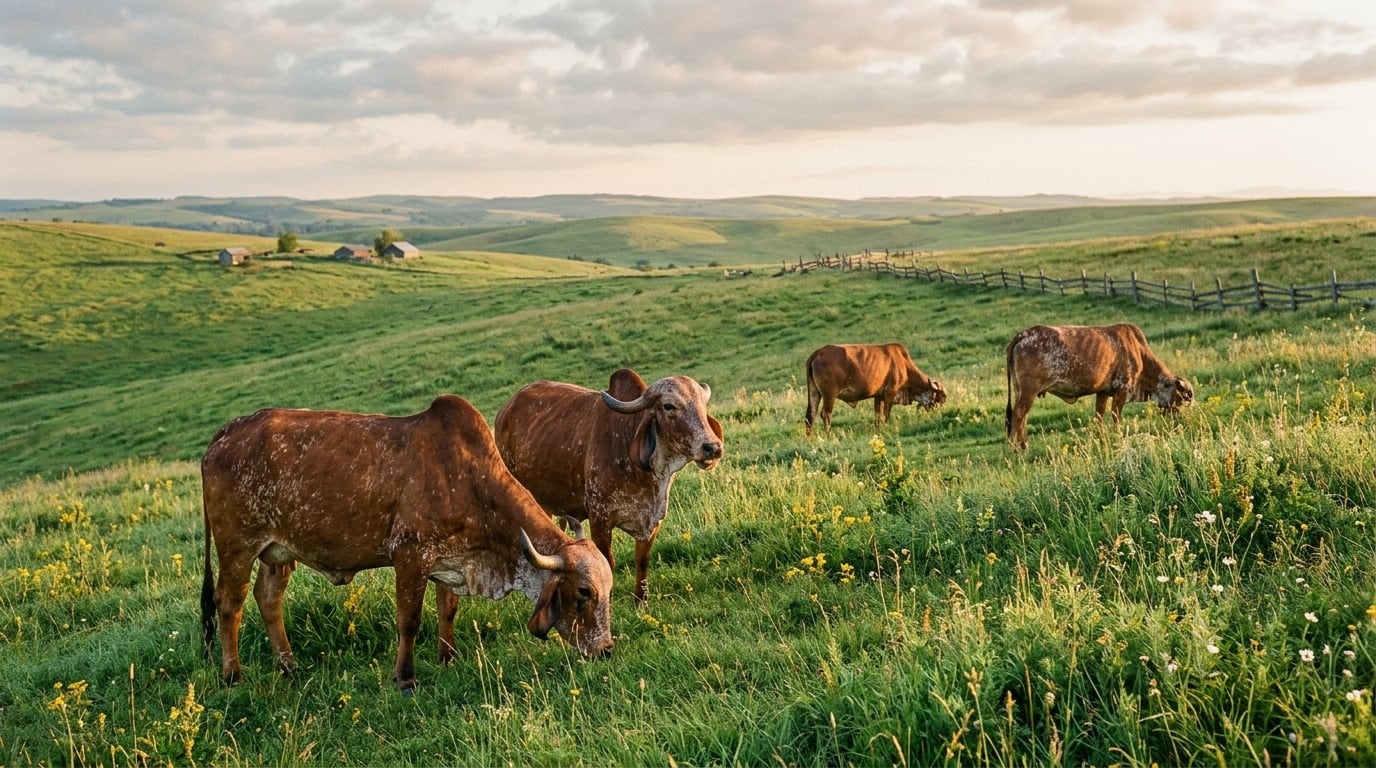
Gomini crafts puja samagri in the foothills of the Himalayas in Darjeeling district - from the milk, ghee and dung of indigenous desi cows that graze at altitude, and from herbs and resins the mountains have long supplied. Offered only through the pandits and retailers we work with by hand.
A movement, not a marketplace
Most puja items in India today are made the way convenience allows - with synthetic dyes for kumkum, industrial chemicals in dhoop, adulterated ghee, and gaumutra whose provenance no one can name.
Gomini exists because the shastras were specific for a reason. Every ingredient in a ceremony has a purpose. Every purpose deserves a preparation faithful to how it was meant to be made.
We do not sell online. We do not ship to homes. We do not run a marketplace.
We work with families raising indigenous desi cows in the Darjeeling foothills. We prepare each item in small batches, at altitude, in our own workshop. And we hand it, quietly, to the pandits and retailers we would ask to lead our own family's worship.
Read our Provenance story →The Framework
Puja is not a catalogue of items. It is a structured practice with named parts. The Gomini Gayatri Framework organises samagri into eight modules - each mapped to a canonical ritual function.
Establishment & adornment
The daily base of the altar and the dressing of the deity - the powders, tilaks and essentials offered every morning.
Composed for daily repetition; mineral colour, not chemical dye; nothing that fatigues the senses or the altar over time.
Purification & fragrance
The preparation of sacred space - the cleansing liquids, resins and fragrance used before the deity is invoked.
Only preparations whose provenance can be named end to end.
The fire offering
The fire and what is offered into it - the fuel, ghee and the grains, seeds and consecrated resins of havan.
The classical shodashratna structure honoured; nothing chemically treated ever enters the fire.
Ritual textiles & threads
Cloth for the altar and the sacred threads - the fabrics, seats and threads that set the vedi.
Natural fibres and ritual colours; no synthetic weaves.
Remedies & festival
The specialty samagri - the botanicals and ritual items of graha-shanti, and what the festival calendar asks for.
Whole-form botanicals of named origin; mineral festival colour; nothing on the altar during a festival that would not belong there on an ordinary day.
The living offering
The fresh and perishable offerings - flowers, leaves, fruit and the living forms the shastra asks for.
Sourced fresh and local; nothing pasteurised or preserved where the shastra asks for the living form.
Sacred implements
The vessels and tools of worship - the thali, kalash, bell, diya-stand and kund that hold and carry the ritual.
Traditional metals and forms; vessels made to be used for a lifetime, not replaced by a season.
The host's preparation
What the host and the officiating priest arrange for themselves - the ceremonial attire and personal provisions of the ritual.
A clear checklist honoured with the same care as the offering; dignity for both the host and the priest.
Provenance
Milk, ghee, dung and gaumutra come from families raising indigenous Siri cattle - the humpless shorthorn native to the Darjeeling district, grazing between 1,200 and 3,000 metres.
Oils are pressed on a wooden ghani. Offerings are weighed by hand. Panchagavya is aged as the classical texts specify. Everything happens at altitude, in our own workshop.
We do not ship to homes. Every module reaches you through a pandit we work with, or a retail partner we have chosen.
The pandit is not our customer. The pandit is the reason Gomini exists. If you conduct karma-kanda, run a puja-samagri store, or supply a temple, we would like to hear from you.
Partner with Gomini →Gomini launches first in Siliguri. Then, city by city, we go where our partners take us. Tell us where you worship. We will tell you when we arrive.
Join the waitlist →Voices
The families raising Siri cattle in the Darjeeling foothills. The pandits who conduct daily karma-kanda across North Bengal, Sikkim and the Dooars. The retailers who have refused to stock adulterated samagri for a generation.
These are the relationships that make Gomini possible. When their words are ready to be published, they will appear here in their own voice - not as endorsements, but as record.
Pandit and farmer voices coming soon. If you conduct karma-kanda and would like to be among the first to receive Gomini modules, write to us.
The Journal
The classical shodashratna havan is a sixteen-element offering with a purpose to each element. Why the factory version misses the point - and how to identify a real one.
What the classical texts actually say about the material of puja - and how to translate those guidelines into decisions a modern Indian household can make.
The Siri is the indigenous humpless shorthorn of the Darjeeling district, Sikkim and Bhutan. What she is, why altitude shapes her, and why she belongs on the altar.
